Salt, concrete and your beds: what winter de-icing does to a property
The damage does not show up in January. It shows up along your kerbs in April.
September 17, 2026 · 4 min read
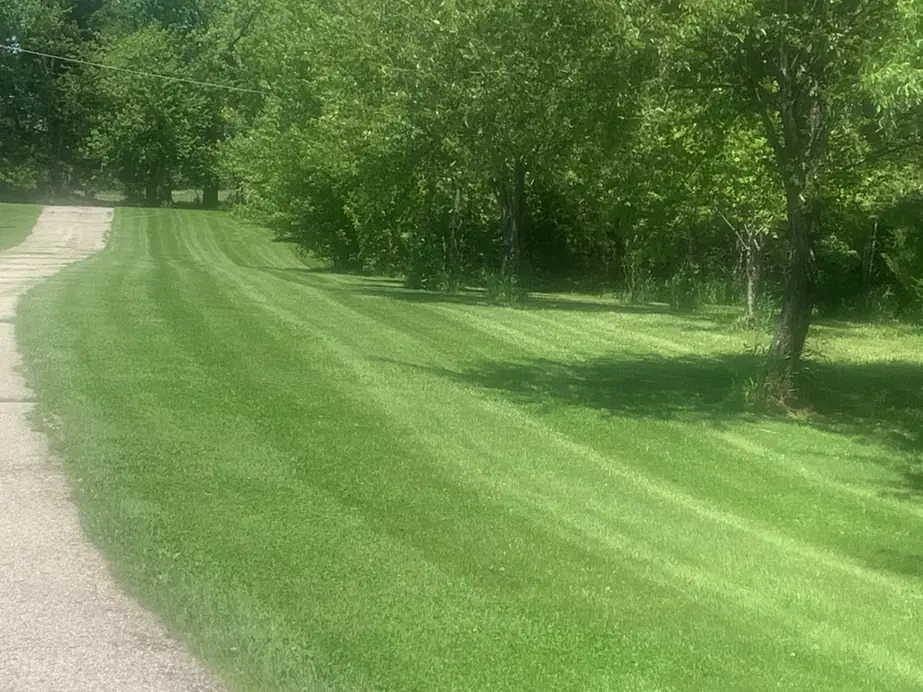
Nobody in northern Illinois is going to stop salting, and nor should they. A commercial property that is not clear and not treated at opening time is a liability, and the cost of getting that wrong is far higher than the cost of some damaged edging.
But salt is not free, and the bill does not arrive in winter. It arrives in spring, along the strips beside the lot, in the first two feet of every bed next to a treated walk, and in the surface of concrete that was fine the year before.
What it does to the grass
Salt damages turf twice over. It draws water out of the roots, so grass in a salted strip effectively dries out even with plenty of moisture around it, and the sodium displaces the structure of the soil so it sets hard and drains badly.
The result is the band everybody recognises: a dead strip a foot or two wide running along every kerb and walk, brown and slow, while the rest of the lawn greens up around it. It is not frost damage and it does not recover on its own quickly.
There is a straightforward remedy if you catch it early. Watering those strips heavily in spring flushes salt down past the root zone, and aerating them first gives it somewhere to go. Done in March or April this makes a real difference; left until June it is a reseeding job.
What it does to concrete
This is the expensive one and it is widely misunderstood. Rock salt does not chemically dissolve concrete. What it does is force many more freeze and thaw cycles in the surface, because it keeps meltwater liquid at temperatures where it would otherwise stay frozen, and that water then refreezes inside the surface pores overnight.
Each cycle pushes the surface apart from within. After enough of them the top few millimetres start to flake off, which is called scaling. Once it starts it does not stop, and resurfacing costs many times what a season of sensible treatment would have.
New concrete is much more vulnerable than old. Anything poured in the last twelve months should not see de-icing salt at all if it can be avoided, which is worth knowing if you have had work done during the year.
Salt is a temperature decision, not a quantity decision
The most common mistake on a cold morning is spreading more. Ordinary rock salt loses most of its effect as temperatures drop, and a Rockford January regularly goes past the point where it is doing anything useful at all. At that point extra salt is just grit with a future cost attached.
When it is genuinely cold, the answer is a different product rather than a bigger pile of the same one. Some materials keep working considerably further down the scale.
The other half of it is timing. Pre treating before a storm is a different job from clearing after one, and it is the better value of the two. It stops the first layer bonding to the surface, so what falls afterwards lifts off cleanly instead of being scraped, which means less salt overall and less wear on everything underneath.
Five things that actually reduce the damage
- Clear first, treat second. Salt is there to stop ice bonding, not to melt a lot of snow.
- Pre treat ahead of a forecast storm rather than reacting after it.
- Plan where the piles go, so meltwater does not run back across a walk and refreeze in the afternoon.
- Keep new concrete out of the salt entirely for its first winter.
- Flush the kerb strips and bed edges with water in early spring, after aerating them.
The eco friendly option, and when it is worth it
We can use an eco friendly salt where it matters, and it is worth asking about if you have beds, young trees, newer concrete or anywhere that run off collects. It is not the right answer for every square metre of every lot, but it is very often the right answer for the areas immediately next to planting and hard surfaces you care about.
There is one more advantage to having the same contractor handle winter that handles the growing season, and it is the whole reason this gets managed well. We already know where your kerbs are under the snow, where the drains are, which beds run right up to the tarmac, and where the sprinkler heads and lighting sit. An operator who has never seen the property green will find all of those, and you will find out which ones in April.
A & A LawnCare, (815) 904-6299
Call (815) 904-6299More articles
When to stop mowing in Rockford, and what the last cut should be
The date on the calendar is the wrong signal. The grass is still growing well after most people have put the mower away.
Why your lawn goes thin in the same three places every year
If the same patches fail every summer, feeding the whole lawn is not going to change it.