Why your lawn goes thin in the same three places every year
If the same patches fail every summer, feeding the whole lawn is not going to change it.
September 17, 2026 · 3 min read
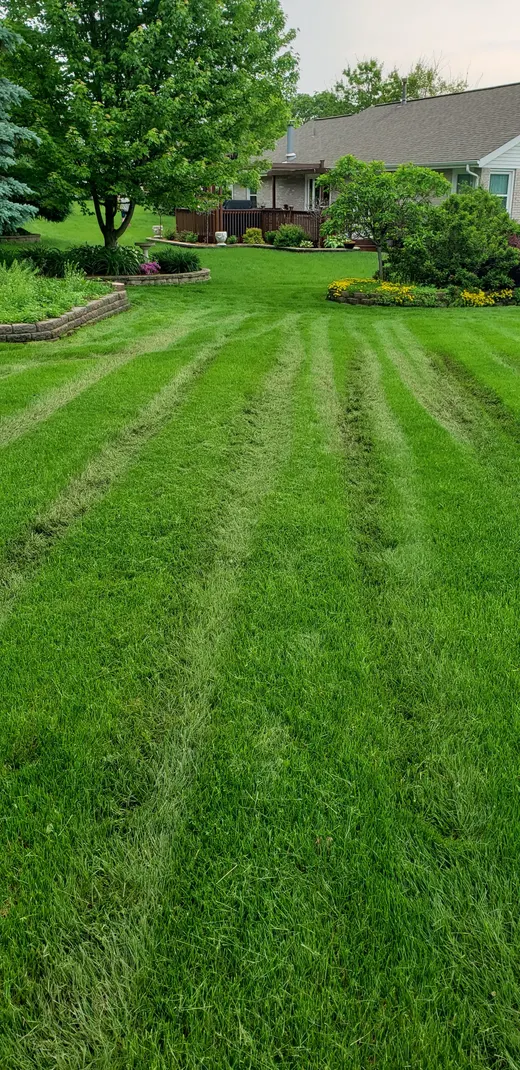
Something we notice on nearly every property we take on around Rockford: the lawn does not fail evenly. There are usually two or three specific areas that go thin, go first in a dry spell, and come back worst in spring, and they are in the same place every year.
That repetition is useful. A lawn that thins randomly is a feeding or watering problem. A lawn that thins in the same footprint annually has a physical cause sitting under it, and until that is dealt with, no amount of fertiliser will make a difference.
Cause one: compaction, which is the common one
The ground across much of Winnebago County is heavy, and heavy soil closes up under pressure. Foot traffic on the route everyone takes to the bins. A trampoline or paddling pool that lived in one spot all summer. A contractor who parked a van on the grass for a fortnight during a job.
Once the soil is compacted, roots cannot get down, water cannot get in, and air cannot circulate. The grass becomes shallow rooted and entirely dependent on surface moisture, so it is the first thing to brown off the moment it stops raining.
You can read it from above before anyone tests anything. Water standing after rain that should have drained. A patch that is always first to go straw coloured. Soil that is hard enough that a screwdriver pushed into it meets real resistance, when the same screwdriver slides into a healthy part of the lawn.
The fix is aerating, and specifically pulling cores rather than punching holes. Spiking pushes soil sideways and compresses it further, which makes the problem worse while looking like treatment. Pulling a core physically removes soil and leaves somewhere for root, water and air to go. Done while the grass is actively growing, the lawn closes the holes itself.
Cause two: shade, and being honest about it
The strip along the north side of a house, the ground under a mature tree, the corner behind a garage. Grass needs light, and below a certain amount it does not thin because it is unhealthy, it thins because there is not enough energy available to hold a full stand.
Shade problems get misdiagnosed constantly, because the symptom looks like every other problem: thin, pale, mossy. People feed it, and feeding grass that is short of light does very little.
There are three honest options. Get more light in, which usually means canopy work to lift or thin a tree rather than remove it. Change what is growing there, using a shade tolerant mix and accepting it will never be as dense as the open lawn. Or stop fighting it and put a bed, mulch or stone there instead, which in the worst spots is genuinely the best outcome.
Cause three: traffic, which is really a design problem
If a worn line runs from the back door to the garage, that is not a lawn failure. That is people taking the shortest route, and they will keep taking it. No seed mix survives being walked on daily.
The cure is either to accept the route and put something down that handles it, stepping stones or a path, or to make the route less convenient. Trying to reseed a desire line every spring is a subscription, not a solution.
How to tell which one you have
- Thin where you walk or park, with hard ground and standing water: compaction.
- Thin on the north side or under a canopy, often with moss: shade.
- A narrow worn line between two points people use: traffic.
- Thin everywhere, evenly, with a yellow cast: that one really is feeding or water.
Why the weeds always arrive in the same patches
Whichever cause you have, the follow on is identical. Thin turf means bare soil, bare soil means light on the ground, and light on the ground is an invitation. Weeds are not invading a healthy lawn; they are occupying the space a thin one left open.
This is why we treat weed control and lawn thickness as one decision rather than two. Killing the weed removes the weed. It does not remove the reason there was room for it, so the same patch produces the same weeds next season, and people conclude the treatment did not work.
If you have got two or three patches you have been quietly annoyed about for years, that is a very solvable problem, and it is worth someone walking the property and telling you which of the three causes you actually have before you spend anything on it.
A & A LawnCare, (815) 904-6299
Call (815) 904-6299More articles
When to stop mowing in Rockford, and what the last cut should be
The date on the calendar is the wrong signal. The grass is still growing well after most people have put the mower away.
Getting a property ready to list: the outdoor jobs that actually move photos
Buyers decide from a thumbnail. Almost everything that decides the thumbnail is outdoors.