Residential and commercial
Lawn care and maintenance
Mowing, feeding, weed control, aerating, rototilling and sod, for homeowners who want the best lawn on the block and for owners who just want it to stop being a problem.
Chapter 01
Cut height is the whole argument
Rockford lawns are cool season grass. Kentucky bluegrass, fescue and ryegrass all grow from a crown at the base of the plant, and they hold their moisture in the leaf. Cut them short and you take away the only shade the root zone has, which is why a lawn scalped in June looks burnt by the middle of July and stays thin into the autumn.
So we mow high and we mow sharp. A blunt blade tears the leaf instead of cutting it, and a torn leaf tip browns off within a day. That is most of the difference between a lawn that reads green from the road and one that reads grey.
We also cut on the interval the grass actually sets rather than a fixed day of the week. Growth in May and early June is hard and fast, and a dry August can go a fortnight without needing anything. One of our customers put it better than we could in their review: we mow it only when it needs mowing.
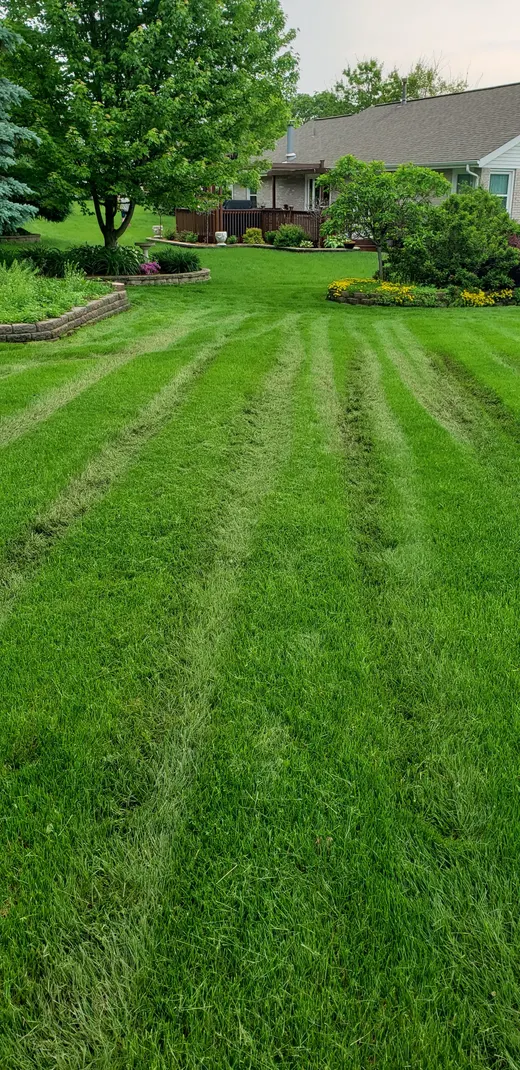
A Rockford back garden cut in clean parallel stripes, with a deck, planting beds and the house behind
Compaction is what aerating is actually for
The ground under most of Winnebago County is heavy. Add foot traffic, a trampoline that lived in one spot all summer, or a contractor who parked on the grass, and the soil closes up. Roots cannot get down, water cannot get in, and the lawn goes thin in exactly the places you walk.
You can read it from above before anyone tests it. Water standing after rain that should have drained, a patch that is always the first to go straw coloured in a dry spell, moss where there is also shade.
We pull cores rather than punching holes. Spiking pushes the soil sideways and makes the compaction worse; pulling a core takes the soil out and leaves somewhere for root, water and air to go. It is worth doing when the grass is actively growing so it closes the holes itself, which in this part of Illinois means spring or early autumn.
Chapter 03
Feeding and weed control are one decision, not two
The real weed control is a thick stand of turf. A weed needs light on bare soil to establish, so anywhere you can see dirt between plants is somewhere a weed has been invited. That is why feeding and broadleaf treatment get sequenced against each other rather than booked as separate jobs.
Treating a weed kills the weed. It does not fix the reason there was room for it, which is usually thin turf, compaction, or a cut height that has been too short for two seasons. We would rather deal with the cause and treat what is left.
Sod, rototilling, and the honest case for starting over
Not every lawn is worth repairing. If more than about half of it is weed, bare ground or the wrong grass entirely, feeding it is just feeding the problem. At that point breaking the ground up and laying sod is cheaper than three years of trying.
The ground has to be doing its job first. We rototill to break the compacted layer, get the grade right so water runs where you want it rather than towards the house, and only then lay turf. Sod put straight onto hard ground roots badly and lifts at the seams.
The first two or three weeks after sod are on you, and they matter more than anything we do. It wants a lot of water, often, until it knits down, and it wants to be left alone by feet and mowers until it does.
What we take with us
Storm cleanup, gutter clearing and light tree limb removal are part of what we do on a maintenance property, not a separate call out. A branch down across the lawn gets dealt with on the visit.
The property is left usable rather than just mown. Clippings off the drive and the path, debris gone, gates shut.
They mow my lawn only when it needs to be mowed, and they do a really great job.